ADVANCED VASCULAR & ENDOVASCULAR INTERVENTIONS

AV Graft Repair

Restoring Reliable Dialysis Access Through Advanced Vascular Care

An arteriovenous (AV) graft provides access to the bloodstream for people undergoing hemodialysis. When a graft develops narrowing, blood clots, or reduced blood flow, dialysis can become difficult or the access may stop working.Dr. Anadi Gupta, MD, FVIR, EBIR, Consultant at Sir Ganga Ram Hospital, provides evaluation and endovascular treatment options for dialysis access complications, including AV graft angioplasty, thrombectomy, and stenting when appropriate.

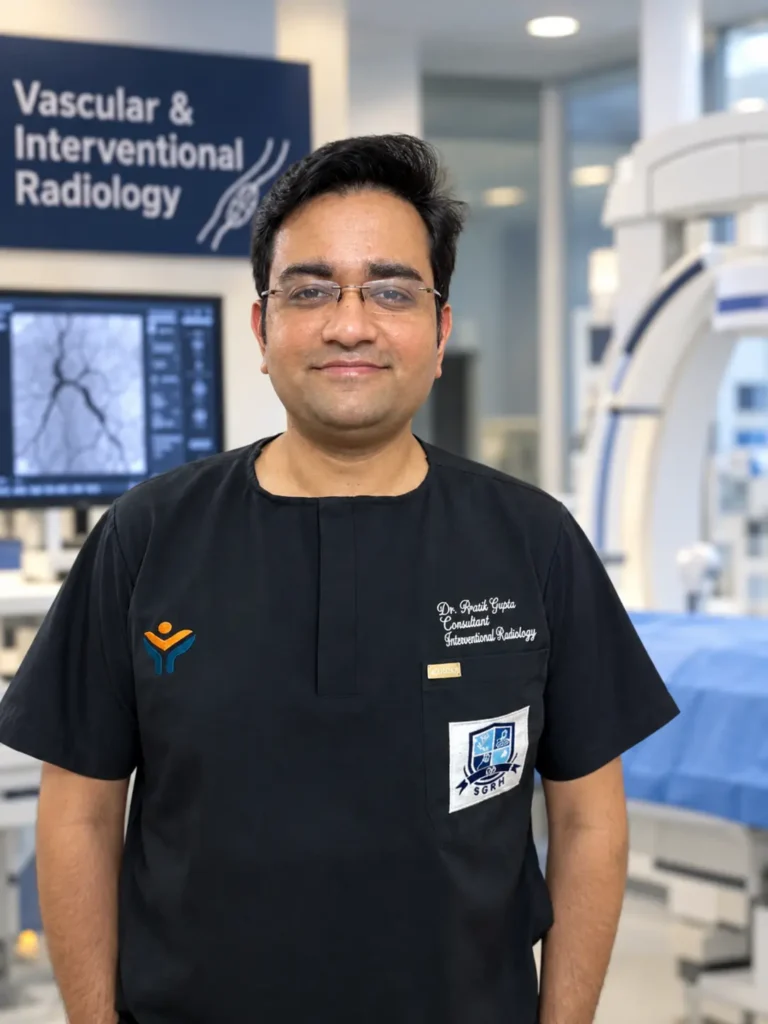
Dr. Anadi Gupta, MD, FVIR, EBIR

Consultant, Sir Ganga Ram Hospital

AV Graft Repair

Understanding AV Grafts for Hemodialysis

What is an AV graft?

An arteriovenous graft is a type of vascular access used for hemodialysis. It connects an artery to a vein using a specially designed synthetic tube, usually placed under the skin of the arm. The graft allows repeated needle access so blood can travel to and from the dialysis machine.Over time, an AV graft may develop narrowing, commonly near the vein connection, or become blocked by a blood clot. These complications can reduce blood flow, increase pressure within the access, and interfere with effective dialysis.

Common Problems

SIGNS YOU SHOULD NOT IGNORE

When Does an AV Graft Need Medical Attention?

Changes in your dialysis access can indicate a problem.Seek medical evaluation if you notice reduced vibration,difficulty during dialysis, prolonged bleeding, arm swelling or if the graft suddenly stops working.

AV Graft Signs

What is AV graft repair?

Advanced Treatment to Restore Dialysis Access

AV graft repair includes procedures designed to restore blood flow through a narrowed or blocked dialysis graft. The treatment is selected according to the location and severity of the problem.

AV Graft Angioplasty

Balloon angioplasty is used to widen a narrowed section of the graft or its draining vein. A catheter is guided to the affected area, and a small balloon is inflated under imaging guidance to improve blood flow.

AV Graft Thrombectomy

If a blood clot blocks the graft, thrombectomy may be performed to remove the clot and restore circulation. Depending on the situation, mechanical clot-removal devices, aspiration techniques, or other methods may be used.

Stenting When Appropriate

A stent may be considered when additional support is needed for selected narrowings or when a lesion is difficult to manage with angioplasty alone. Stenting is not necessary in every case and must be planned with consideration for future dialysis access options.

Evaluation of Venous Outflow

Sometimes, the problem is not limited to the graft itself. Narrowing in the draining veins or central veins can contribute to swelling, increased pressure, and access dysfunction. Additional imaging and treatment may be needed to address the underlying cause.

Who may benefit from AV graft repair?

Is AV Graft Repair Right for You?

A vascular and endovascular specialist may evaluate patients who have:
  • Narrowing of the AV graft or its draining veins.
  • Partial or complete blockage caused by blood clots.
  • Reduced graft blood flow affecting dialysis.
  • Repeated high venous pressure readings during dialysis.
  • Prolonged bleeding after dialysis needle removal.
  • Arm swelling related to impaired venous drainage.
  • Recurrent graft dysfunction after previous interventions.
  • A dialysis graft that has suddenly stopped functioning.

How is AV graft repair performed?

The AV Graft Repair Process

Consultation and Assessment

Dr. Anadi Gupta reviews the patient's dialysis history, symptoms, previous access procedures, and any recent problems during dialysis.

Diagnostic Evaluation

A clinical examination and Doppler ultrasound may be used to assess blood flow and identify narrowing or clot formation. Fistulography or other imaging may be required to evaluate the access circuit in more detail.

Personalized Treatment Planning

The specialist determines whether angioplasty, thrombectomy, stenting, surgical revision, or another approach is most appropriate.

Image-Guided Intervention

A catheter is introduced through a suitable access point. Balloon angioplasty is performed for narrowing, while an appropriate thrombectomy technique may be used when a clot is present. A stent may be placed in selected cases.

Assessment of Access Function

The team evaluates blood flow through the graft and checks for immediate complications. The access is assessed to determine whether it is suitable for dialysis use.

Follow-Up and Access Monitoring

Follow-up helps assess graft function and identify recurrent narrowing or clotting. The treating team will advise when the graft can be used for dialysis and whether additional monitoring is required.

  • May restore or improve blood flow through a narrowed or blocked dialysis graft.
  • Can help address clot formation and narrowing that interfere with dialysis.
  • May help preserve an existing dialysis access and reduce the need for a new access procedure.
  • Catheter-based treatment may avoid open surgery in selected cases.
  • Can support the timely resumption of dialysis when access function is successfully restored.
  • Bleeding or bruising at the access site.
  • Injury or rupture of the blood vessel during intervention.
  • Recurrent narrowing or clot formation.
  • Incomplete restoration of blood flow or early graft failure.
  • Infection or other access-related complications.
  • Contrast-related reactions or kidney complications in susceptible patients.
  • Stent-related complications when a stent is used.
  • Need for repeat intervention, surgical revision, or another access procedure.
1

Why consult Dr. Anadi Gupta?

Specialized Vascular & Endovascular Care

Dr. Anadi Gupta, MD, FVIR, EBIR, is a Consultant at Sir Ganga Ram Hospital with a focus on vascular and endovascular interventions.His areas of practice include AV graft repair through angioplasty, thrombectomy, and stenting when appropriate, as well as AV fistula repair, central venous angioplasty and stenting, DVT thrombectomy, peripheral arterial interventions, and IVC filter insertion and retrieval.

ADVANCED DIALYSIS ACCESS CARE

Experiencing AV Graft or Dialysis Access Problems?

Get your dialysis access assessed and explore suitable treatment options with Dr. Anadi Gupta, Consultant at Sir Ganga Ram Hospital.

Frequently Asked Questions

AV Graft Repair

Can a blocked AV graft be repaired?

Many narrowed or blocked grafts can be assessed for treatment using angioplasty, thrombectomy, or another suitable procedure. The likelihood of success depends on the cause, duration, and severity of the blockage.

An AV fistula connects an artery directly to a vein. An AV graft uses a specially designed tube to connect an artery and a vein. Both can provide access for hemodialysis.

Angioplasty is generally a minimally invasive, catheter-based procedure performed under imaging guidance. Some complications may require surgical revision or another treatment approach.

Not always. Balloon angioplasty alone may be sufficient for some narrowings. A stent is considered in selected situations after evaluating the lesion and future access needs.

Yes. Recurrent narrowing and clot formation can occur. Monitoring and timely evaluation of new dialysis access problems are important.

The timing depends on the procedure and the condition of the graft. Your treating specialist and dialysis team will confirm when it is safe to use the access.

If the usual vibration disappears or the graft suddenly stops functioning, contact your dialysis team and seek urgent medical assessment. Do not wait for your next routine dialysis session.